Unit 1: Computational Thinking and Programming – 2
Revision of Python topics covered in Class XI.
Functions: types of function (built-in functions, functions defined in module, user defined functions), creating user defined function, arguments and parameters, default parameters, positional parameters, function returning value(s), flow of execution, scope of a variable (global scope, local scope)
Exception Handling: Introduction, handling exceptions using try-except-finally blocks
Introduction to files, types of files (Text file, Binary file, CSV file), relative and absolute paths
Text file: opening a text file, text file open modes (r, r+, w, w+, a, a+), closing a text file, opening a file using with clause, writing/appending data to a text file using write() and writelines(), reading from a text file using read(), readline() and readlines(), seek and tell methods, manipulation of data in a text file
Binary file: basic operations on a binary file: open using file open modes (rb, rb+, wb, wb+, ab, ab+), close a binary file, import pickle module, dump() and load() method, read, write/create, search, append and update operations in a binary file
CSV file: import csv module, open / close csv file, write into a csv file using writer(),writerow(),writerows() and read from a csv file using reader()
Data Structure: Stack, operations on stack (push & pop), implementation of stack using list.
Unit 2: Computer Networks
Evolution of networking: introduction to computer networks, evolution of networking (ARPANET, NSFNET, INTERNET)
Data communication terminologies: concept of communication, components of data communication (sender, receiver, message, communication media, protocols), measuring capacity of communication media (bandwidth, data transfer rate), IP address, switching techniques (Circuit switching, Packet switching)
Transmission media: Wired communication media (Twisted pair cable, Co-axial cable, Fiber-optic cable), Wireless media (Radio waves, Micro waves, Infrared waves)
Introduction to web services: WWW, Hyper Text Markup Language (HTML), Extensible Markup Language (XML), domain names, URL, website, web browser, web servers, web hosting
Unit 3: Database Management
Database concepts: introduction to database concepts and its need
Structured Query Language: introduction, Data Definition Language and Data Manipulation Language, data type (char(n), varchar(n), int, float, date), constraints (not null, unique, primary key), create database, use database, show databases, drop database, show tables, create table, describe table, alter table (add and remove an attribute, add and remove primary key), drop table, insert, delete, select, operators (mathematical, relational and logical), aliasing, distinct clause, where clause, in, between, order by, meaning of null, is null, is not null, like, update command, delete command, aggregate functions (max, min, avg, sum, count), group by, having clause, joins: cartesian product on two tables, equi-join and natural join
Interface of python with an SQL database: connecting SQL with Python, performing insert, update, delete queries using cursor, display data by using connect(), cursor(), execute(), commit(), fetchone(), fetchall(), rowcount, creating database connectivity applications, use of %s format specifier or format() to perform queries
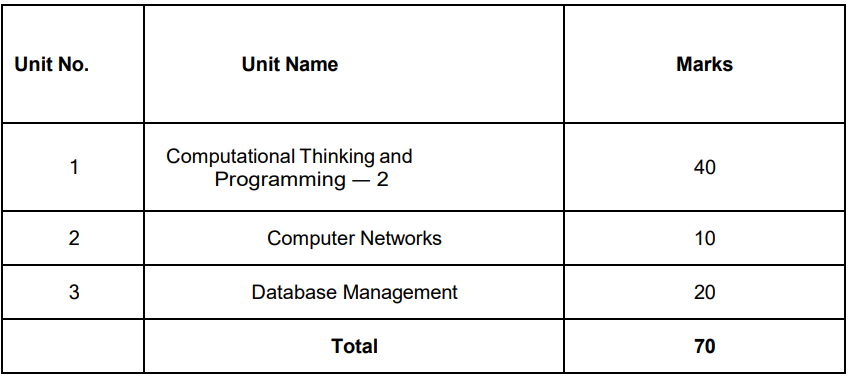
Distribution of Marks – Theory
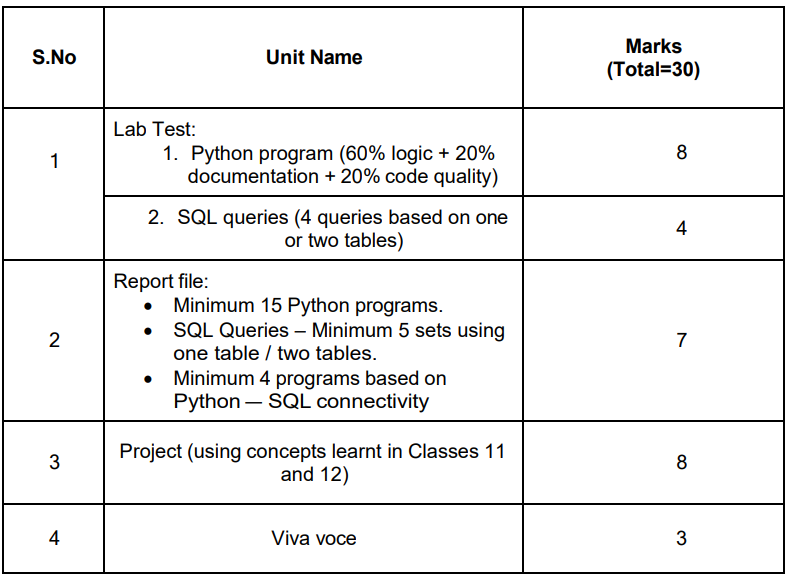
Distribution of Marks – Practical
Study Buddy
Your AI Buddy
Hello! How can I assist you today?
Hey there! I am your Study Buddy! Do you have a question?